Part 1: How advertising builds CEP associations

 Back to articles
In the world of marketing, the ultimate goal of advertising is not simply to make people aware of the brand’s name, but to ensure that the brand is thought of at crucial moments – the moments when consumers are thinking about buying the category. Achieving this requires that the brand occupies a dominant space in the consumer’s memory, ready to be recalled when different situations, needs, or desires arise. The mechanism that enables this is the human brain’s associative memory system.
This article explores how advertising builds connections between a brand and category entry points (CEPs) – the cues that trigger buying behaviour – by working in harmony with the way our brains naturally form, strengthen, and retrieve mental associations.
Our brains are hard-wired to make decisions based primarily on what comes quickly to mind via mental associations (memories). We don’t store facts, experiences, feelings in neat, separate boxes. Instead, we create mental networks where one memory triggers other connected memories – potentially lots of them. This is called associative memory.
When we encounter something – a smell, a sight, a feeling – it can trigger memories, emotions, and thoughts linked to that experience. For example, the smell of sunscreen might make you think of the beach; the sight of a birthday cake might remind you of childhood parties; feeling thirsty on a hot day might bring to mind a cold soda.
This is how brands need to work their way into your thoughts: by linking themselves (e.g. via advertising) to situations that lead to purchases. The more these associations are established and reinforced, the more likely it is that the brand will come to mind in buying situations. The findings of the Ehrenberg Bass Institute support this conclusion.
But how are these associations formed in people’s minds?
Brand connections are formed just like other memories – via what’s known as ‘classical conditioning’ – a learning process that occurs when two (sets of) stimuli are repeatedly paired.
You may have heard of Dr Pavlov’s experiments with dogs.
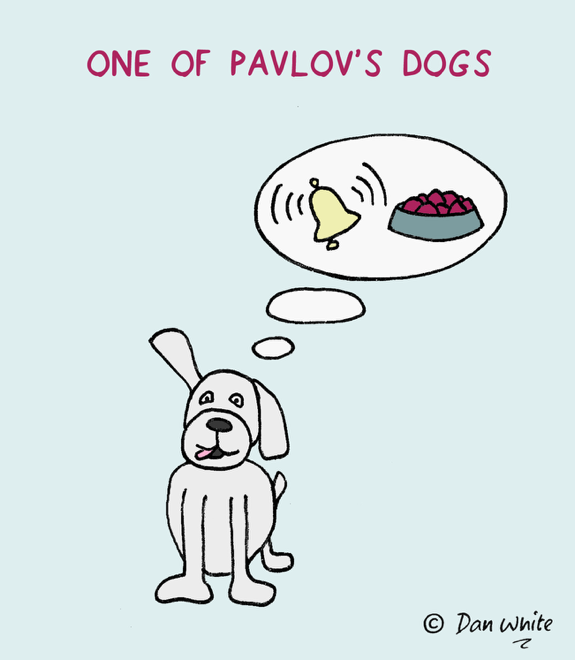
He routinely rang a bell when he fed his dogs. After a while, the dogs started to salivate as soon as they heard the bell, before being presented with any food. Brand associations are built in the same way. Brands become associated with Category Entry Points if they use marketing activities to repeatedly conjure up the CEP at the same time as conjuring up the brand in people’s minds. As psychologists say, “Neurons that fire together, wire together.” Once these mental links have become established, the brand will spring to mind the next time someone experiences the related usage context.
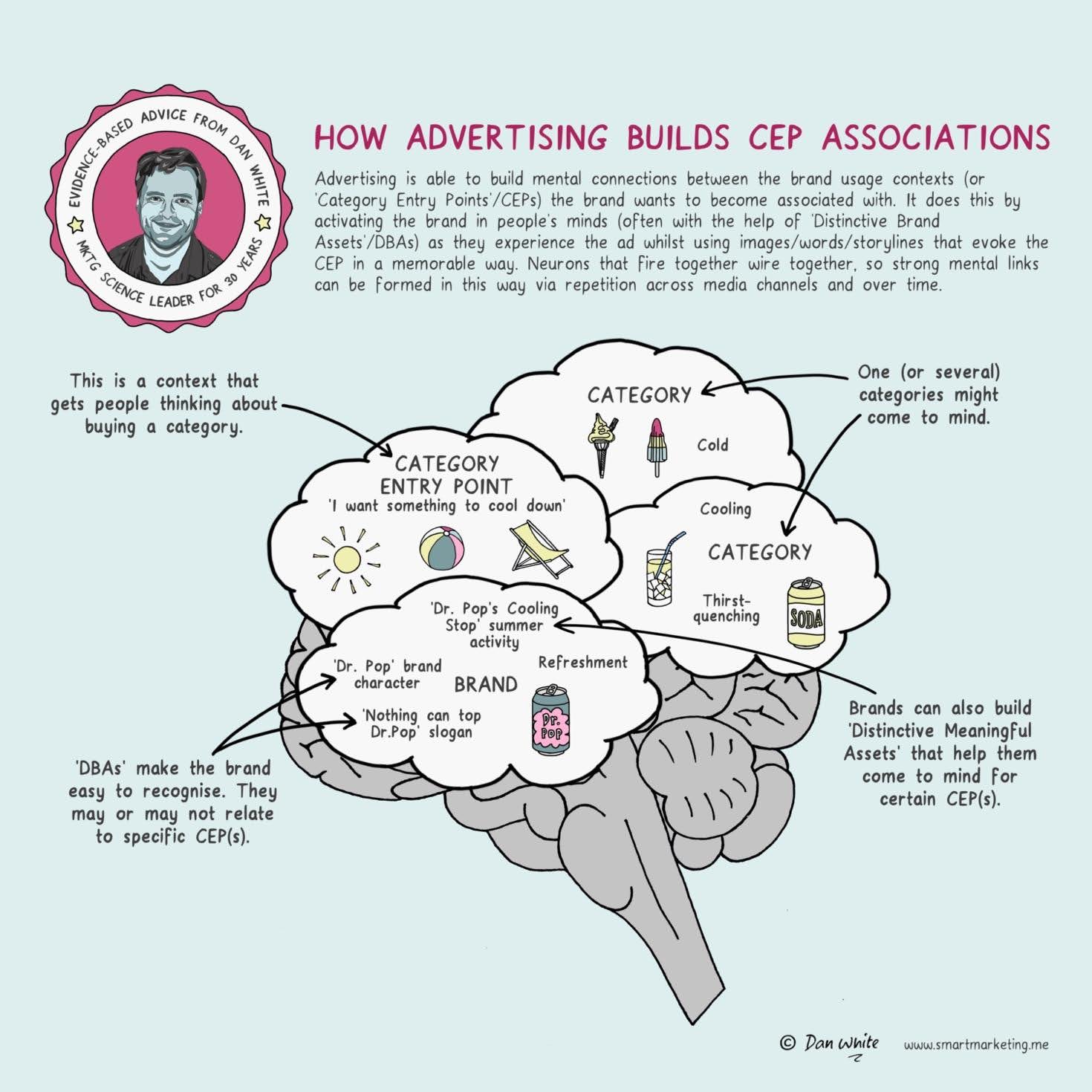
So, what, exactly, should brand owners do if they want to develop advertising that will forge these connections? How can they make sure both the brand and the CEP are activated in people’s minds as they experience the advertising?
The trick, I believe, is to leverage mnemonics. Mnemonics are easy ways to remember and recall things. “Richard of York Gave Battle in Vain” is an easy way to remember all the colours in the visible spectrum. Slogans, jingles, mascots and graphical symbols are examples of mnemonics used by marketers to help people remember brands. These are known as ‘Distinctive Brand Assets’ (or DBAs) and their value has been proven by the Ehrenberg Bass Institute. Some DBAs automatically help a brand come to mind for certain CEPs. For example, the cuddly bear character used by Unilever’s fabric conditioner brand Snuggle helps it come to mind when parents are thinking about having blankets and clothing that are soft and cosy for a baby.
However, Jenni Romaniuk from Ehrenberg Bass Institute argues that DBAs should be meaning-free so they can be used to evoke the brand in people’s minds in perpetuity, even if the brand decides to expand into new areas, where the DBA’s original connotations may no longer be relevant. If so, how should brands aim to create mental connections with different usage needs and occasions?
Do brands need to build ‘Distinctive Meaning Assets’ as well as DBAs? DMAs are similar to DBAs in that they need to become strongly associated with the brand. Unlike DBAs, the role of DMAs is to connect a brand with a meaningful usage need or occasion. A DMA could be used for years to help the brand ‘own’ a usage occasion, but eventually, it may need to make way for new DMAs as consumers’ needs and the brand’s growth priorities change.
Like DBAs, DMAs can be words/phrases, graphical symbols, other sensory experiences or usage rituals that are promoted repeatedly to connect the brand with a CEP in the minds of consumers.
Part 2 of this article will highlight the various ways brands have succeeded in associating themselves with different Category Entry Points.

Leisure & Travel

Escape to experience: how travel motivation is changing in 2026

FMCG
A new appetite: How FMCG brands can innovate for the GLP-1 consumer

Financial Services
From observing to owning: the convergence of media and fashion

Financial Services